
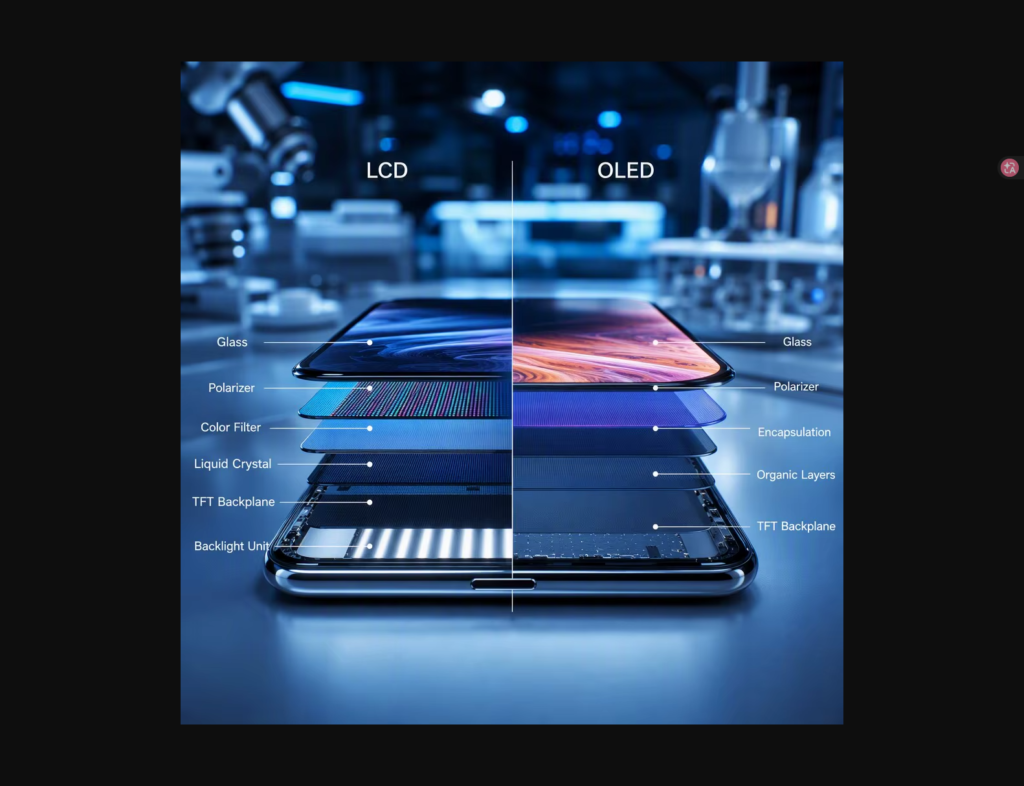
Apple’s iPhone display technology has undergone a remarkable transformation over the years, evolving from traditional LCD (Liquid Crystal Display) panels to the stunning OLED (Organic Light Emitting Diode) screens we see today. This evolution reflects not only advancements in display technology but also Apple’s commitment to delivering superior visual experiences to its users worldwide.
The LCD Era: From TFT to Retina HD
The iPhone’s display journey began with a modest 3.5-inch TFT LCD on the original iPhone (2007), delivering just 163 pixels per inch (PPI). Apple revolutionized mobile displays in 2010 with the iPhone 4’s Retina display, pushing resolution to 326 PPI — a density where individual pixels become indistinguishable to the human eye at typical viewing distances. The iPhone 6 through iPhone 8 series (2014-2017) continued refining IPS LCD technology, achieving peak brightness of 625 nits, sRGB color accuracy, and improved contrast ratios of approximately 1400:1. These LCDs relied on a constant backlight, meaning blacks appeared as dark gray rather than true black, and power consumption remained relatively high regardless of displayed content.
The OLED Revolution: Super Retina and Beyond
In 2017, Apple made a paradigm shift with the iPhone X, introducing its first OLED display branded as “Super Retina.” Unlike LCDs that require a backlight, each OLED pixel emits its own light independently, enabling true blacks by simply turning off individual pixels. This fundamental difference delivers an effectively infinite contrast ratio (approximately 1,000,000:1), HDR10 and Dolby Vision support, and the expansive DCI-P3 wide color gamut covering 100% of the color space. Modern iPhone 15 Pro models push peak HDR brightness to an impressive 1600 nits, with outdoor peak brightness reaching 2000 nits — a dramatic leap from the 625 nits ceiling of LCD iPhones.
Key Technical Comparison
Contrast Ratio: LCD ~1400:1 | OLED ~1,000,000:1 (effectively infinite)
Peak Brightness: LCD (iPhone 8) 625 nits | OLED (iPhone 15 Pro) 2000 nits outdoor
Power Efficiency: OLED consumes up to 30% less power when displaying dark-mode content
Response Time: LCD 5-8ms | OLED <0.1ms — eliminating motion blur
Color Gamut: LCD ~85% DCI-P3 | OLED 100% DCI-P3 with Delta E <1 color accuracy
Repair Considerations for Professionals
For repair businesses, the shift from LCD to OLED brings both opportunities and challenges. OLED replacement screens are significantly more expensive — typically 2-3x the cost of comparable LCD panels. The flexible substrate of OLED displays makes them more fragile during installation; improper handling can easily result in dead pixels, green line artifacts, or uneven brightness. When sourcing wholesale replacement displays, always verify whether you’re purchasing original OEM panels, high-quality aftermarket OLEDs, or budget LCD conversion kits. Original OLED panels guarantee True Tone functionality and optimal color calibration, while premium aftermarket OLEDs from reputable Shenzhen suppliers can deliver excellent performance at 40-60% of OEM cost. Before completing any iPhone display repair, thoroughly test for touch sensitivity uniformity across the entire screen, brightness consistency at all levels, and True Tone/ambient light sensor compatibility to ensure customer satisfaction.