
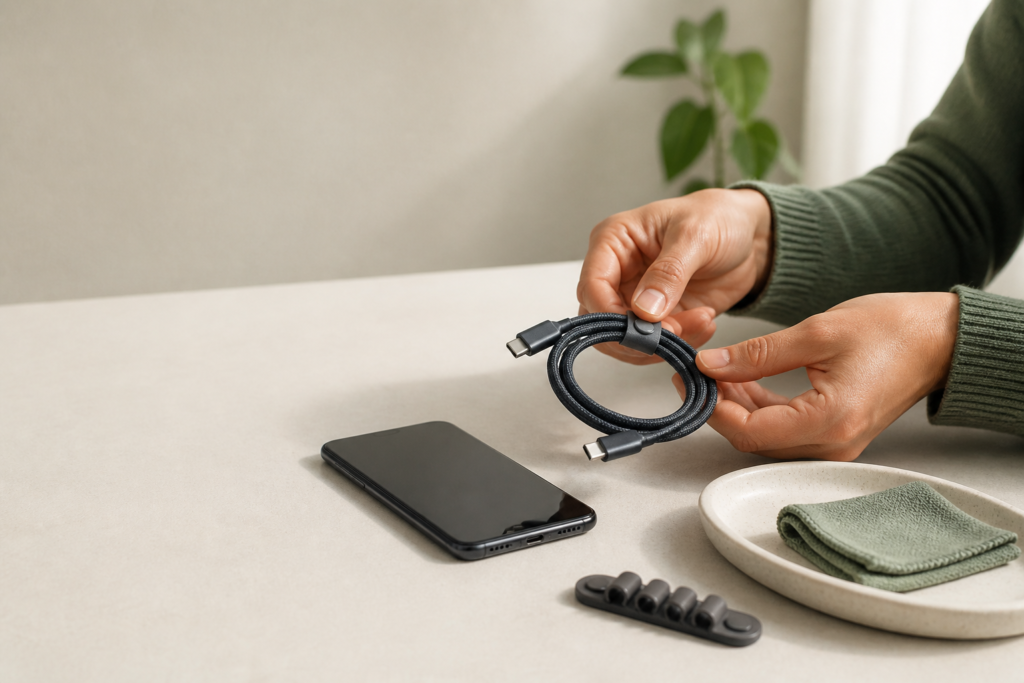
Charging cables usually fail at points that are handled repeatedly: the connector, the cable exit, and the bend near a desk or wall adapter. Good daily habits cannot change the design of a cable, but they can reduce unnecessary stress and make problems easier to spot.
Pull the connector, not the cable
When disconnecting a phone, hold the plug housing rather than pulling the cable itself. This keeps force away from the strain-relief area and reduces side loading on the connector.
Use a relaxed coil
Wrap the cable in a loose loop that follows its natural curve. Avoid tight knots, sharp folds, or winding the cable around a very small object. A small organizer or soft tie can keep the coil neat without compressing it.
Keep the connector clean
Dust and pocket debris can prevent a connector from seating correctly. Inspect the plug and phone port in good light and use a suitable dry cleaning method. Never force a connector that does not align naturally.
Store cables away from pressure
Do not place heavy items on top of a coiled cable or close it inside a hinge. During shipping or warehouse storage, separate cables from sharp edges and keep loose metal objects away from the connector housing.
Replace at the first warning sign
Stop using a cable if the connector becomes loose, the outer jacket is damaged, or charging behavior becomes intermittent. A replacement is safer and often less frustrating than continuing to bend a damaged cable.
Careful handling is simple: use the plug housing, coil loosely, keep connectors clean, and replace damaged accessories promptly. These habits improve day-to-day reliability without making claims about a specific cable’s construction.